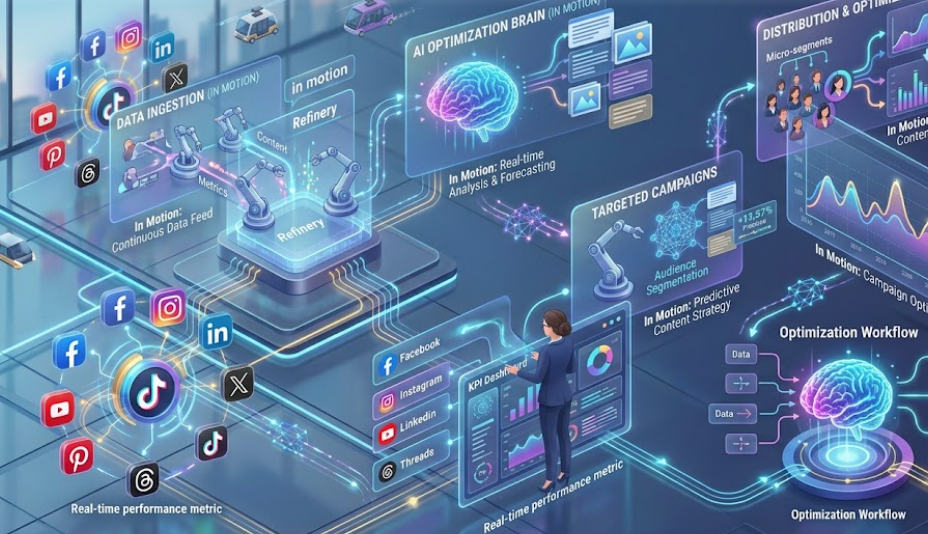
If your competitors seem to post everywhere, all the time, without burning out their teams — they're probably using AI. AI social media marketing has quietly gone from a nice-to-have to the engine behind most high-performing social strategies in 2026, and this guide shows you exactly how it works, what tools to use, and how to get real results from it.
What Is AI Social Media Marketing?
AI social media marketing means using artificial intelligence tools to plan, create, schedule, publish, analyze, and optimize your social media activity. That's a broad definition — intentionally so — because AI now touches nearly every part of the social media workflow.
A few years ago, AI in marketing meant spam filters and product recommendations on Amazon. Today it means a small business owner can produce a week's worth of Instagram content in under an hour, automatically find the best time to post, and get a plain-language report explaining what worked and why.
The numbers back this up. According to Salesforce's State of Marketing 2026 report, 87% of marketers now use generative AI in at least one recurring workflow — up from 51% just two years ago. Sociality.io's 2026 AI in Social Media Marketing report found that 89.7% of social media professionals use AI at least several times a week. This isn't fringe experimentation. It's the new standard operating procedure.
For small businesses, agencies, freelancers, and content creators, that shift creates a real opportunity. AI levels the playing field. You don't need a 10-person content team to show up consistently on Instagram, LinkedIn, TikTok, and Facebook. You need the right tools and a clear strategy.
How AI Is Changing Social Media Marketing
The most immediate impact of AI on social media marketing is speed. Tasks that used to take hours — brainstorming caption ideas, writing five post variations, resizing graphics for different platforms, picking optimal posting times — now take minutes.
But speed is only part of the story. AI also changes the quality ceiling for teams without specialist skills. A solo founder with no copywriting background can now produce captions that sound natural and brand-consistent. A small agency can scale from managing 5 client accounts to 20 without adding headcount.
Here's where AI is making the biggest difference right now:
● Content creation: AI writing tools like Jasper, ChatGPT, and Copy.ai generate platform-specific captions, hooks, ad copy, and campaign ideas in seconds. You provide the brief; AI handles the first draft.
● Scheduling and automation: Platforms like Buffer and Hootsuite use AI to analyze your audience's behavior patterns and recommend the best times to post — specific to each platform and your specific audience, not generic industry averages.
● Visual content: Canva's AI tools handle resizing, background removal, and template generation. Over 71% of social media images are now AI-assisted in some way, according to SQ Magazine's 2026 report.
● Analytics and reporting: Instead of digging through dashboards, AI surfaces the insights that actually matter — which posts drove the most reach, which formats your audience responded to, and what to do differently next month.
● Social listening: Tools like Sprout Social and Brandwatch scan millions of mentions, comments, and conversations to surface what people are saying about your brand — and alert you to trends before they peak.
● Ad optimization: Meta's Advantage+ system and similar AI ad tools generate multiple ad variations, test them simultaneously, and automatically shift budget toward the combinations that perform best.
The Best AI Social Media Marketing Tools in 2026
Not every AI tool fits every team. Here's a practical breakdown by use case so you can build a stack that actually matches how you work.
Tool | Best For | Standout AI Feature | Starting Price |
Buffer | Freelancers, small businesses, startups | AI caption generation + best-time-to-post from your own data | Free / $6 per channel/month |
Hootsuite | Agencies, larger teams, multi-brand management | OwlyWriter AI for captions, content calendar, social listening | $99/month |
Sprout Social | Brands focused on engagement and data depth | Trellis social intelligence, sentiment analysis, Smart Inbox | Contact for pricing |
Jasper | Teams producing high-volume branded content | Brand voice training — learns your tone from examples | From $49/month |
Canva | Visual-first content creators and marketers | Magic Design, background removal, AI image generation | Free / $15/month |
ChatGPT / Claude | Solo operators and content ideation | Flexible, conversational content drafting across formats | Free / $20/month |
AdCreative.ai | Paid social advertisers | AI-generated ad creative variants for A/B testing | From $29/month |
Brandwatch | Enterprises tracking brand reputation | Deep competitive intelligence and real-time listening | Enterprise pricing |
A quick word on tool selection: resist the temptation to subscribe to ten tools at once. Start with one content creation tool and one scheduling tool, run them for 30 days, then add analytics once you're posting consistently. More tools don't automatically mean better results — clear workflows do.
How to Build an AI Social Media Strategy That Actually Works
AI doesn't replace your social media strategy — it executes it faster. If your strategy is unclear, AI will produce polished content that goes nowhere. Get the fundamentals right first, then let AI handle the heavy lifting.
Step 1: Define your audience and goals before touching any tool
Who are you trying to reach? What do you want them to do after seeing your content? These questions sound basic, but most businesses that struggle with AI-generated content skipped this step. They ended up with well-written posts that didn't resonate because the AI had no real direction.
Write down your audience profile — their job, their problems, what they're looking for on each platform — and your primary goal per platform (brand awareness on Instagram, lead generation on LinkedIn, community on Facebook). Feed this to your AI tools as context, not just a topic.
Step 2: Choose your platforms based on where your audience actually is
You don't need to be everywhere. You need to be where your buyers spend time, and post consistently enough to be recognized.
For B2B audiences: LinkedIn is non-negotiable. Add YouTube if you produce educational content. For B2C, especially visual or lifestyle products: Instagram, TikTok, and Pinterest. For local businesses: Facebook still drives more local engagement than any other platform in the US. AI tools let you repurpose content across platforms quickly, but quality always beats quantity — two platforms done well beat five platforms done poorly.
Step 3: Build a content mix, not just a content calendar
A common mistake is treating AI as a caption machine and filling your feed with promotional posts. Audiences tune that out fast.
A practical content mix for most businesses: — 40% educational content (tips, how-tos, industry insights) — 30% engagement content (questions, polls, behind-the-scenes) — 20% social proof (testimonials, case studies, results) — 10% promotional (offers, services, calls to action)
Give this breakdown to your AI tool when generating ideas. Instead of asking "write me 10 Instagram captions," ask "write me 4 educational captions about [topic], 3 engagement questions, 2 testimonial frameworks, and 1 promotional caption for [service]." You'll get dramatically more usable output.
Step 4: Use AI to create, then review before you publish
AI drafts. You decide. This is the single most important principle for teams using AI in social media marketing.
Even the best AI tools produce generic or off-brand output when given vague prompts. And 97% of companies still apply human oversight to AI content, according to research from Chad Wyatt's 2026 AI marketing statistics compilation — for good reason. A 2-minute review per post catches the phrases that sound technically correct but don't sound like you. It also catches factual errors, which AI tools still produce.
Set up a simple review step: draft with AI, review for brand voice and accuracy, then schedule. That workflow is faster than writing from scratch and more reliable than posting AI content without checking it.
Step 5: Let AI analyze, then act on what it tells you
Most teams use AI for content creation but don't use it for analytics — and that's where a lot of value gets left on the table.
Tools like Sprout Social, Hootsuite, and even Buffer's basic analytics can identify your top-performing content formats, your best posting days, and patterns in what's driving engagement versus what's just getting impressions. Check these numbers monthly, not weekly. Social media performance tends to be noisy week-to-week; monthly trends tell you something worth acting on.
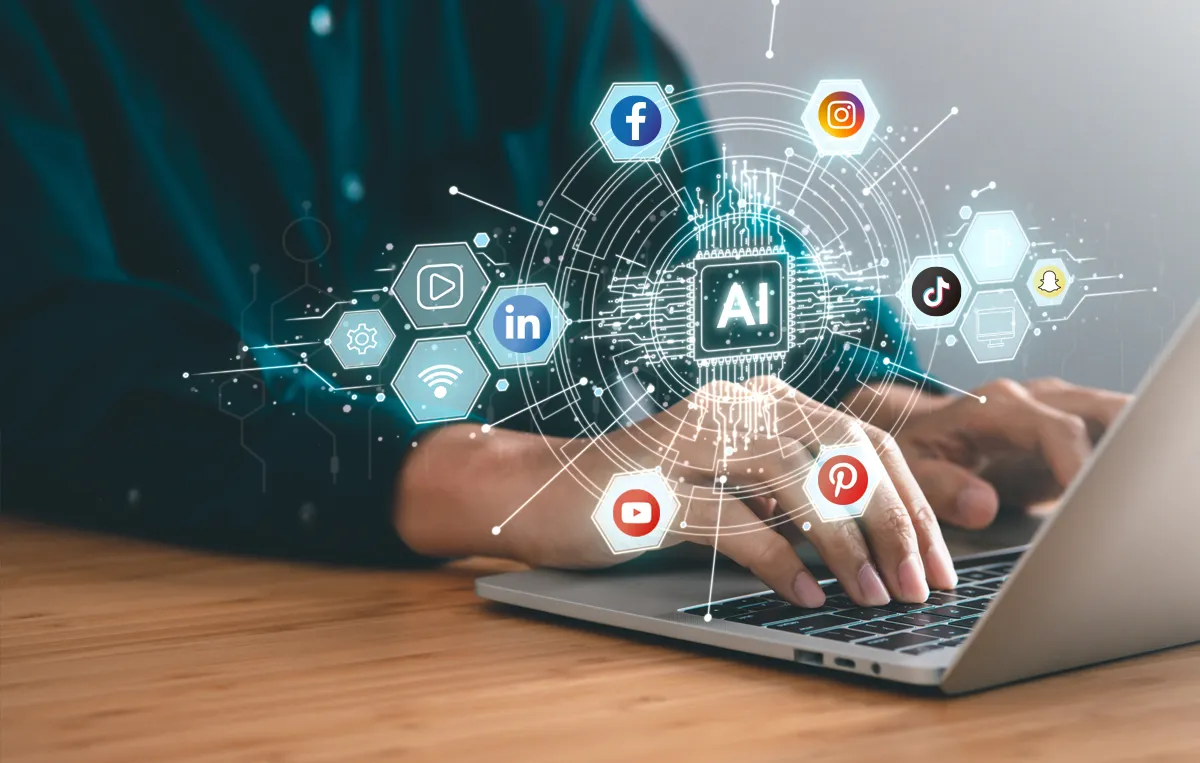
Different platforms reward different content types, and AI tools behave differently across them. Here's what to know before you start.
AI for Instagram Marketing
Instagram favors Reels above almost everything else in 2026. AI video tools like CapCut and Canva Video can generate short-form clips, add captions automatically, and suggest trending audio. For static posts and carousels, Jasper and Buffer AI generate strong caption drafts — but make sure you're using Reels-specific hooks (first 3 seconds matter enormously) rather than standard caption formats.
AI for LinkedIn Marketing
LinkedIn's algorithm rewards long-form insight posts, not promotional updates. AI writing tools work well here for drafting thought leadership content, but the best-performing LinkedIn posts still sound like a person wrote them. Use AI to draft, then rewrite the opening line yourself — that first sentence is what determines whether someone clicks "see more" or scrolls past.
AI for Facebook Marketing
Facebook's AI ad system (Meta Advantage+) is one of the most powerful AI tools available to small businesses, and most aren't using it to its full potential. For organic content, Facebook Groups tend to outperform business pages for engagement. AI tools can help you respond to comments at scale via Hootsuite's smart inbox features.
AI for TikTok Marketing
TikTok's algorithm is the most AI-driven of any social platform — it decides who sees your content based on watch time, replays, and completion rate, not follower count. That means a small account can go viral if the content hooks viewers immediately. Use AI to generate video scripts, but keep them short (under 30 seconds for most B2C content) and start with a direct statement rather than an intro.
AI for YouTube Marketing
YouTube rewards longer content and search intent. AI tools like VidIQ and TubeBuddy help with keyword research, title optimization, and thumbnail testing. For script writing, AI works best on tutorial and explainer formats — give it a structure (problem, solution, step-by-step, CTA) and it produces solid first drafts that you refine.
AI Social Media Marketing for Small Businesses: Real Talk
Small businesses often assume AI social media marketing is something enterprises do with big budgets. The reality is the opposite — AI benefits smaller teams more because it compensates for the resources they don't have.
A retailer with one person managing their entire online presence can use Buffer's free plan to draft, schedule, and analyze posts across four platforms without hiring an agency. A freelance consultant can use ChatGPT to produce three LinkedIn posts a week in less time than it used to take to write one.
The catch: AI won't fix an unclear offer or an undefined audience. If you're not sure what makes your business different, or you're posting without a clear goal, AI will just help you produce that confusion faster and at higher volume.
Here's a practical starting stack for a small business with a limited budget: — ChatGPT or Claude (free tiers) for content ideation and caption drafts — Canva (free tier) for visual creation — Buffer (free for up to 3 channels) for scheduling — Google Analytics + native platform insights for performance review
That's $0/month to start. Once you're posting consistently and seeing results, you can invest in paid plans for the features that actually matter to your workflow.
AI Social Media Automation: What to Automate (and What Not To)
Automation and AI are related but different. Automation means setting up tasks to happen without manual input — scheduled posts, auto-replies, content queues. AI means using machine learning to make better decisions about what to create, post, and optimize.
Both are valuable. Both have limits.
Automate these tasks:
● Post scheduling — set your content queue a week in advance
● Best-time-to-post recommendations — let the platform pick based on your data
● Basic comment responses to FAQs — tools like Hootsuite can suggest templated replies
● Monthly performance reports — AI summarizes the data so you don't have to dig through dashboards
● Content repurposing — automatically adapt a long LinkedIn post into 3 shorter Twitter/X posts
Keep humans in the loop for:
● Responses to complaints or negative feedback — these need a human, every time
● Crisis communications — AI should never be the voice of your brand in a PR situation
● Creative campaign decisions — AI informs them; you make the call
● Relationship building — genuine community management still requires a real person
The brands that get the most out of AI automation are the ones that use it to free up time for the human interactions that actually build loyalty. AI handles the repetitive tasks; your team handles the conversations that matter.
Measuring the ROI of AI Social Media Marketing
One of the most common questions from business owners is: does this actually work? Fair question. Here's what the data shows and how to measure it for your own business.
According to Salesforce's 2026 State of Marketing report, marketers using AI agents reclaim an average of 8 hours per week and report a 20% lift in marketing ROI. Separately, 78% of marketers in a Mirra 2026 survey reported increased productivity after implementing AI social media tools, with average time savings of more than 6 hours per week.
Those are meaningful numbers — but averages hide a lot of variation. Teams that see high ROI from AI tools tend to share a few traits: they had a clear strategy before adopting AI, they maintained human review of AI-generated content, and they tracked specific metrics rather than just "engagement."
For your own measurement, track these by platform and month:
● Reach: Are more people seeing your content? Growth here means your posting frequency or content quality improved.
● Engagement rate: Likes, comments, and shares as a percentage of reach. This tells you whether content quality improved, not just volume.
● Link clicks / traffic: Is social media actually sending people to your website? This connects social activity to business outcomes.
● Lead or inquiry volume: For service businesses especially, this is the number that matters most.
● Time spent on content creation: Track how many hours your team spends on social media monthly. AI should reduce this number over time.
Set a baseline before you start using AI tools, then check back after 60-90 days. That time window is usually long enough to separate genuine improvement from normal variation.
AI Social Media Marketing Trends to Watch in 2026 and Beyond
The pace of change in AI marketing tools is fast. Here are the developments that will matter most to business owners and marketers over the next 12-18 months.
AI agents that manage full campaigns autonomously
Meta's AI advertising systems already handle full campaign creation — images, video, copy, targeting, and budget allocation — for advertisers who opt in. This is expanding. Expect AI agents that can run a 30-day social media campaign from a single brief, with minimal human input beyond approval checkpoints.
The trust gap is a real competitive advantage
Here's something most AI marketing articles won't tell you: consumer trust in AI-generated content is falling. Sprout Social's Q1 2026 Pulse Survey found that 50% of Gen Z have unfollowed, muted, or blocked accounts because they suspected the content was AI-generated. Brands that use AI for efficiency but maintain a clear human voice will stand out — and that gap is only going to widen as AI content floods social feeds.
Hyper-personalization at scale
AI-driven personalization shows a 35% lift in purchase frequency and a 21% boost in average order value, according to research cited by theStacc's AI social media statistics report. As more platforms give businesses access to first-party data and AI segmentation tools, personalized social ad experiences will become the norm rather than the exception.
AI for social listening will outpace content creation tools
Right now most businesses use AI primarily to create content. Over the next 18 months, expect to see AI-powered social listening — understanding what your audience is saying, feeling, and searching for — become equally important. Tools like Brandwatch and Sprout's Trellis are already pointing in this direction.